

The history behind the “Patris” and its exhibits in the museum
21/10/2025
COLLECTIONS & EXHIBITS
On 28 October 1856, the “Hellenic Steamship Company” was founded— a private steamship company with significant support from the National Bank of Greece and the Greek state. In late 1856, following a proposal by G. Stavros, the General Assembly of shareholders decided to establish the company’s headquarters in Hermoupolis, Syros.
In 1860, the paddle steamer Patris joined the company’s fleet, along with three other steamships: Amalia / Eunomia, Eptanisos, and Byzantion. Neither the Patris nor the Amalia / Eunomia enjoyed good fortune.
The Patris, one of the finest—if not the finest—vessels owned by the Hellenic Steamship Company of Syros, was delivered to the company in 1860 from England, following an order placed by King Otto, the first king of Greece. Until his dethronement, the ship even bore his name. Unfortunately, it sank in the bay of Koundouros on the island of Kea, a loss that proved significant for the Hellenic Steamship Company.
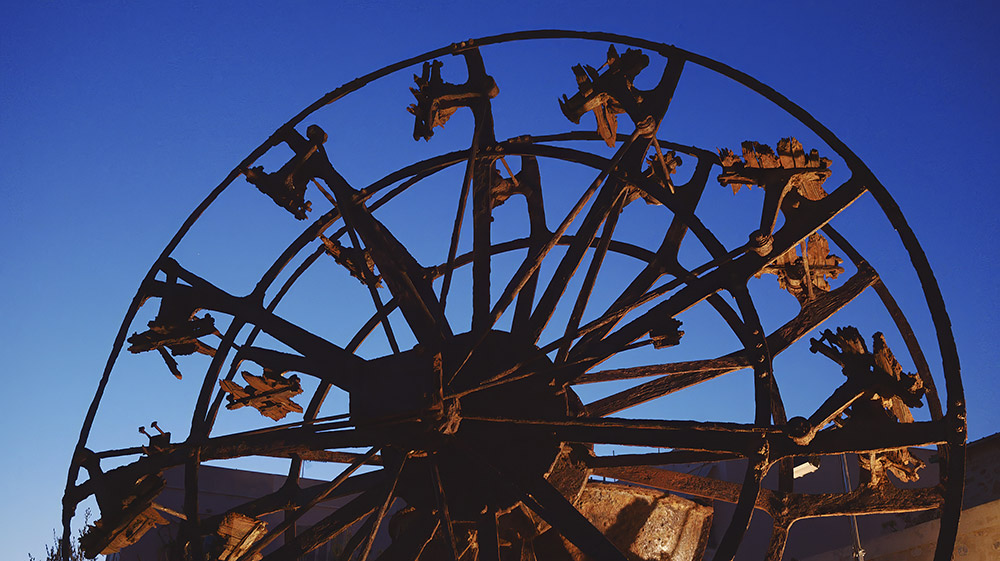
The discovery of the Patris shipwreck is of great importance, as it represents a typical example of a type of steamship powered by paddle wheels, prior to the widespread use of propellers. In 2007, with sponsorship from the family of shipowner George Mich. Pateras and under a collaboration permit from the Ephorate of Underwater Antiquities, research began— including surveying, photography, the collection of surface finds, and the recovery of one of the two paddle wheels.
Hellenic Radio & Television (ERT) and the Industrial Museum of Hermoupolis, with sponsorship from the Pateras family, co-produced the 63-minute documentary “Steamer Patris, lost in 1868”. Production began in October 2006 and required at least two years to complete. Dedicated to the memory of George Mich. Pateras, the documentary has participated in numerous Greek and international festivals and has received important distinctions, including at The Archaeology Channel Festival in Eugene, Oregon, USA. During the underwater research and filming, one of the ship’s two paddle wheels— weighing 14 tons and lying at a depth of 55 meters—was successfully raised above water. Along with the wheel, one of the two anchors, the ship’s two cannons, and several surface finds were also recovered.
A single glance at the objects recovered from the wreck—displayed in the dedicated corner of the Museum’s third hall—is enough to transport visitors to the atmosphere of another era. English porcelain tableware, ornate iron structures, and elegant artifacts, many bearing the emblem of the Company, are all on display at the Industrial Museum of Hermoupolis. Outdoors, behind the Museum, stands one of the vessel’s two side paddle wheels, now one of the Museum’s most iconic and recognizable exhibits.